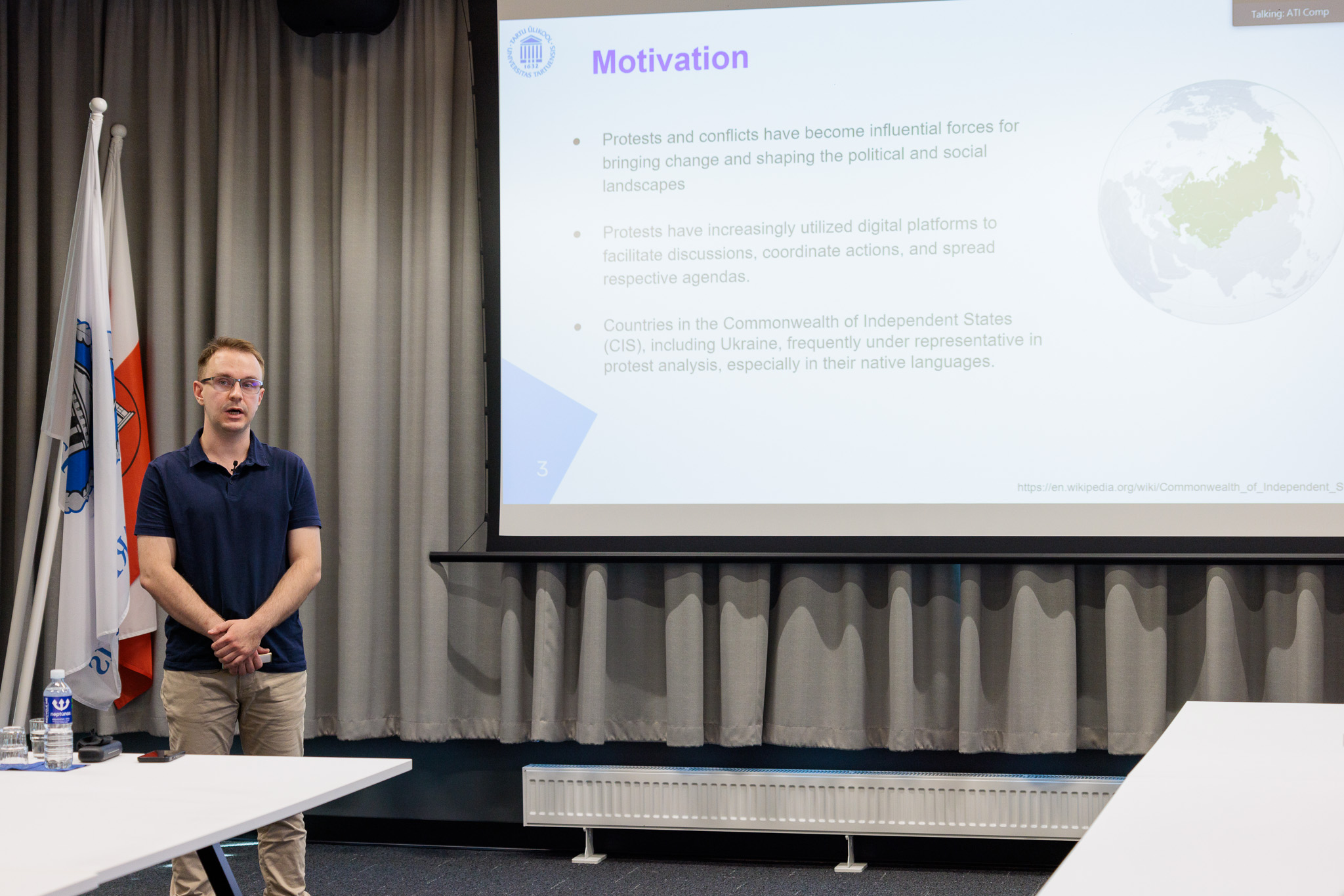
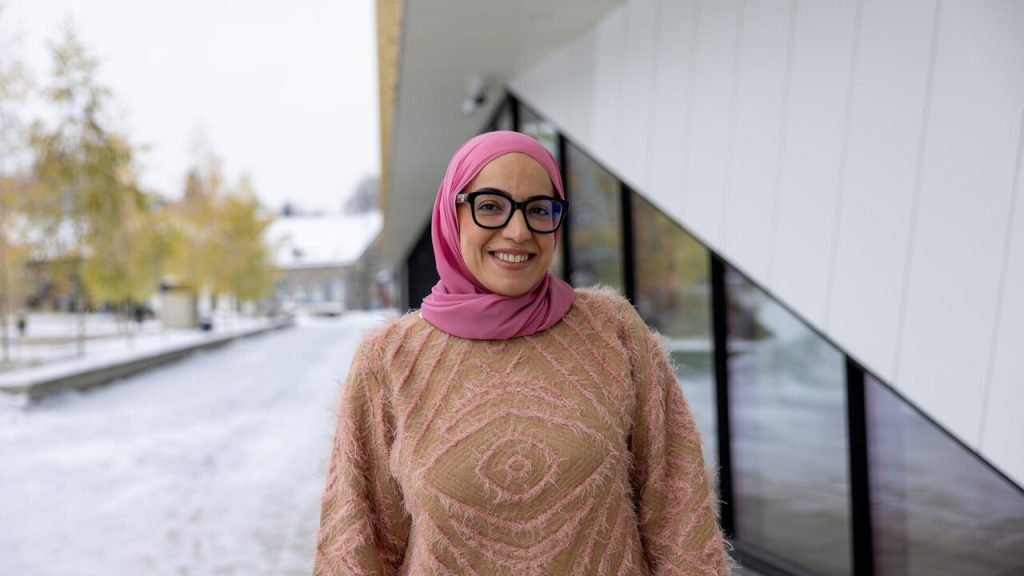
Radwa El Shawi shares her journey and research at the University of Tartu, at the Chair of Data Science, where she focuses on democratizing machine learning to make AI more accessible, explainable, and human-centered. She was interviewed by Professor Jaak Vilo, Head of the Institute of Computer Science.
How did you start doing science and come to Estonia?
My path into science began with an early fascination for how data can be shaped into knowledge. During my PhD at the University of Sydney, I explored geometric networks and algorithms — work that taught me to think rigorously about how information flows. Over time, this curiosity evolved into a central guiding question for my career: How do we democratize machine learning so it becomes accessible, explainable, and genuinely human-centered?
Estonia felt like the right place to pursue that vision. With its strong digital infrastructure and openness to innovation, the University of Tartu offered a collaborative environment where algorithmic research naturally connects to societal impact. I joined the Institute of Computer Science in 2018, and Tartu has been my academic home ever since.
Describe your current research group.
I lead the Data Systems Group, which develops the methodological and system-level foundations needed to make machine learning a practical, off-the-shelf solution for real-world problems. Our research integrates automated model development, explainable artificial intelligence, and scalable learning systems, with the goal of designing and combining these components so they operate reliably in applied settings. We explore how to automate ML pipelines end-to-end, enabling the entire modeling process to run with minimal manual intervention while remaining robust when deployed on distributed, privacy-restricted, or resource-limited data platforms. Collaborations in healthcare, and agriculture, provide complex datasets and concrete requirements that shape our research agenda. This integrated perspective allows us to view machine learning not only as an algorithmic challenge but as a complete system that must be interpretable, reproducible, and deployable in real operational contexts.
What are the main challenges in establishing your own research group?
The most significant challenge is attracting and securing strong researchers who have the technical depth and motivation to work on complex, interdisciplinary topics. Competition for talent is extremely high, and building the right team requires both time and resources. In parallel, sustaining long-term projects depends on obtaining competitive funding, maintaining productive collaborations with domain experts, and ensuring that students have a clear research direction and support structure.
How would you describe the main research directions of your group?
Our research follows a single thread: making machine learning trustworthy and useful for people who are not ML experts. From this emerge three interconnected directions — automating model development, designing explanations that align with human understanding, and scaling ML under real-world constraints like privacy or limited resources. These directions feed into one another, forming a cycle of automate → explain → scale that guides our work across all domains.
I know you have some fascinating results and services actually delivered based on your research contributions. Please tell the story.
One of the most impactful systems developed through my research emerged from a collaboration with the Houston Methodist DeBakey Heart & Vascular Center in the USA. Clinicians needed a solution to predict patient outcomes that was not only accurate but also transparent enough to support medical decision-making. While existing machine-learning models delivered strong predictive performance, their explanations were too abstract to be clinically useful.
To bridge this gap, we designed a concept-based explanation framework that connects model decisions to medically relevant concepts rather than raw features. This system enables experts to review, and refine the model’s reasoning, creating a feedback loop where clinical knowledge directly informs the predictive process. The result was a model that combines high performance with alignment to established medical understanding.
The success of this system had a broader influence on our research trajectory. The insights gained from building a clinically interpretable model now guide our work in other domains, including agriculture.
Where can readers find out more about these results?
Our work is showcased on the Data Systems Group website: https://bigdata.cs.ut.ee
Open-source tools and prototypes live on GitHub: https://github.com/DataSystemsGroupUT/
My publications and research outputs are listed on ETIS https://www.etis.ee/CV/Radwa_El%20Shawi/est/ , with links to major conference and journal papers.
How do you best embed your research into the courses, how do you attract students, members of research groups?
I integrate my research directly into teaching through the course Explainable Automated Machine Learning, which I introduced into the Data Science curriculum. The course provides students with hands-on experience in ML pipeline automation, explanation techniques, and evaluation methods using real datasets and tools developed by our group. Students are exposed to open research questions early on, which often inspires them to pursue thesis topics or research projects within the group.
I involve students and new group members in research from the start. They get to work on real projects, try out tools, and explore open questions. Being part of the process lets them see how research works in practice and decide how they want to contribute.
Anything else?
If there is a single idea that unites my work, it is that machine learning should serve human understanding, not replace it. Accuracy matters — but so do transparency, usability, and societal trust. Anyone who shares this view, whether student or collaborator, is always welcome to join us in exploring it further.