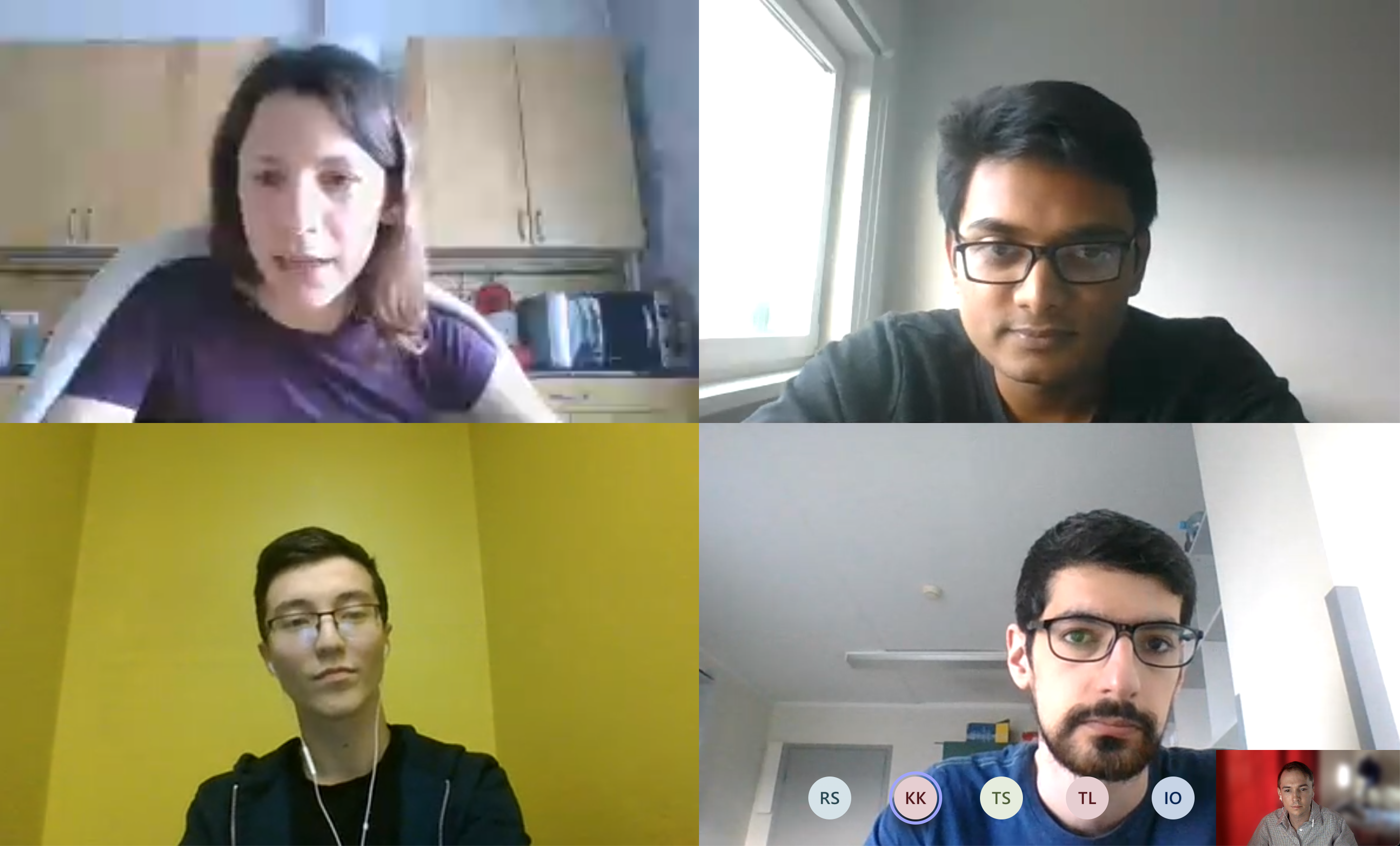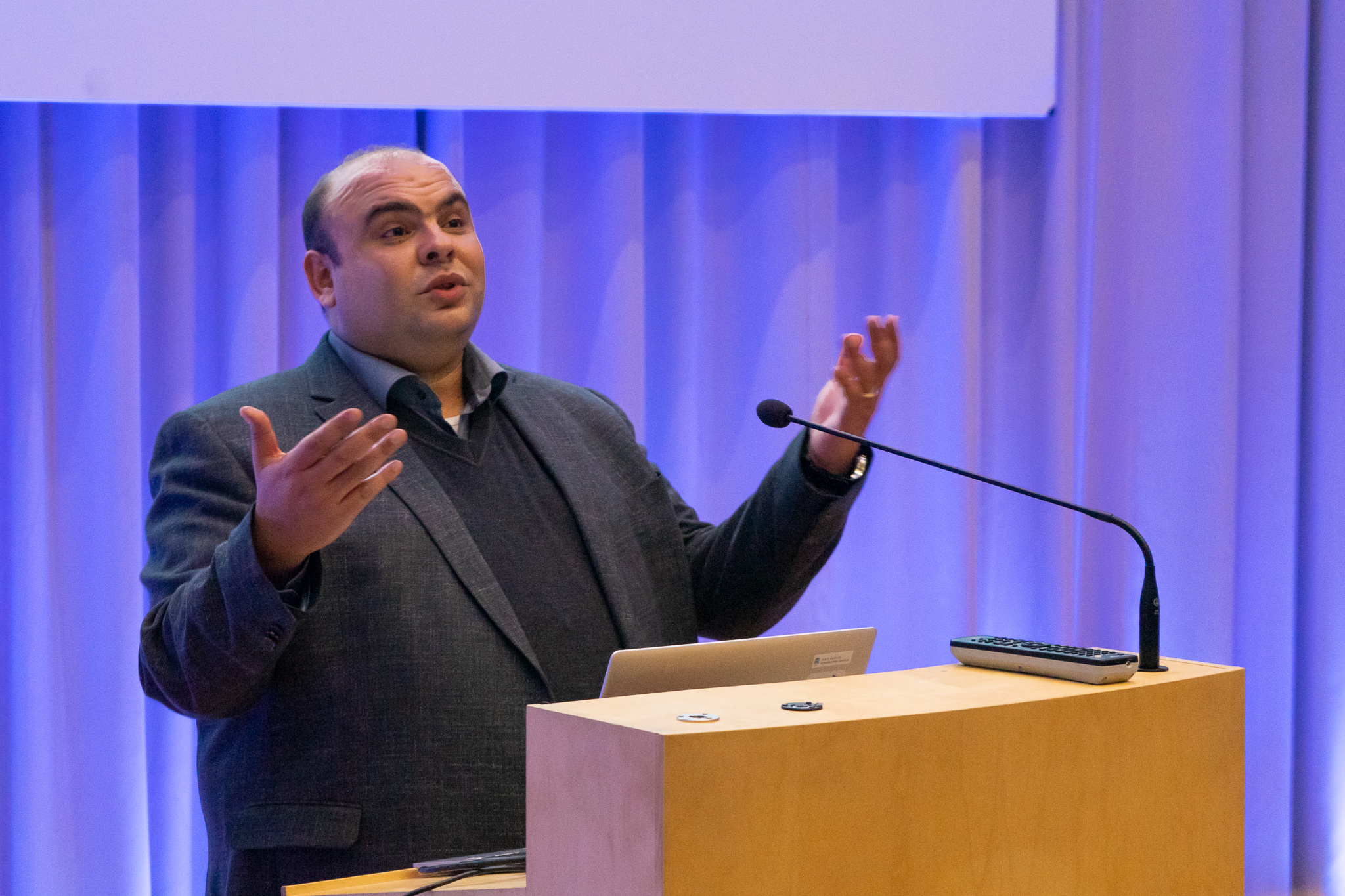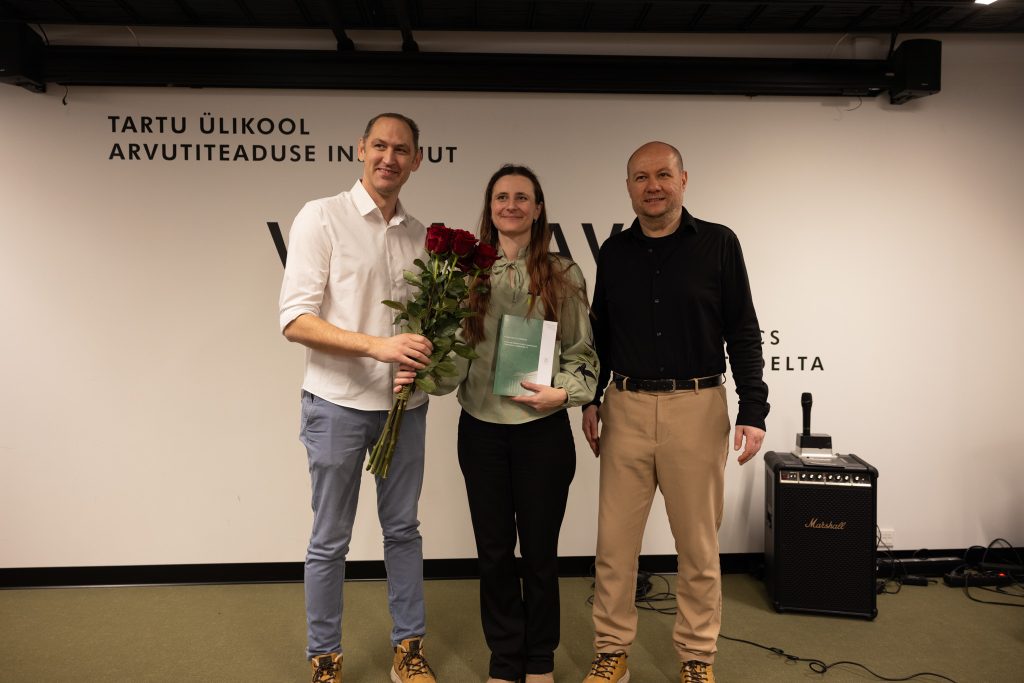
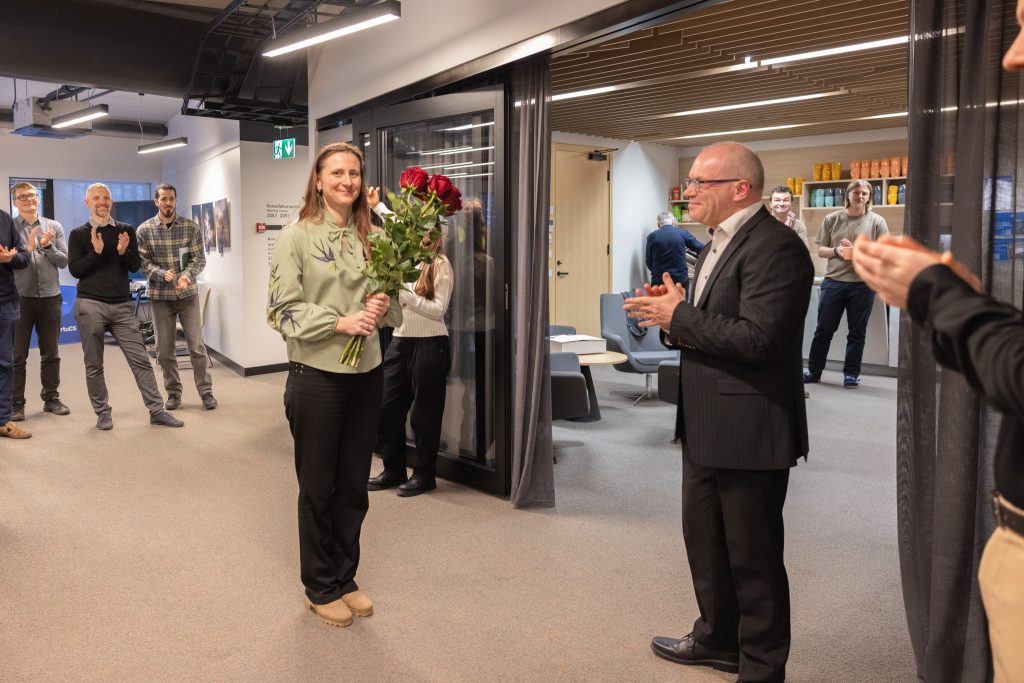
On 15 January 2026, Marharyta Dominich defended her doctoral dissertation titled “Advancing human-centric counterfactual explanations in explainable AI” (supervised by Raul Vicente and Eduard Barbu). On this occasion, Professor Jaak Vilo, Head of the Institute of Computer Science, spoke with Marharyta about her journey into research so far and the possible next steps in her academic and professional path.
How did Estonia enter the picture for you?
I first came to Estonia to study for a Master’s degree in Computer Science at the University of Tartu, which I completed between 2017 and 2019. It may seem like a coincidence that life brought me to Estonia and that I pursued my PhD here, but in reality, it is the result of the work of many people who built the Institute of Computer Science at the University of Tartu. Honorable mention goes to Dmytro Fishman, whose enthusiastic promotion of Tartu in Ukraine during my bachelor’s studies encouraged me to apply for a master’s studies here. That event, together with receiving a scholarship, ultimately shaped the path that brought me to this point.
The excellent teaching I received during my master’s studies also played an important role. Dmytro Fishman and Mari-Liis Allikivi showed me how inspiring and approachable PhD students can be. Seeing Mari-Liis as a researcher and teacher at the Institute gave me a female role model to look up to and a path I could imagine following.
Why did you decide to pursue a PhD in the first place?
After my master’s degree, I went back to Ukraine for a short trip: to get married and return. Then COVID happened. Flights were cancelled, borders closed, and I ended up being stuck for half a year. During that time, I considered every possible option. I applied for a PhD through the main call to Jaan Aru’s project and I was also applying for other jobs. I was rejected from that PhD position, there was already a stronger candidate, my future colleague and a good friend Tarun. Luckily, almost at the same time, I found a job as a Machine Learning Engineer at KappaZeta. That year in industry was a great experience, with a lot of work done and a lot of responsibility. It also led to an important realization that I was capable of doing different work and started to carry bigger ambitions. At the same time, I noticed that I missed a connection to the AI research community in Estonia, philosophical conversations about the state of AI, and, more generally, a sense of being recognized in such a community. Around that time, coincidentally, Raul Vicente contacted me with a PhD proposal and we had a very lengthy discussion about explainability and life that clicked very well. It felt like the right kind of challenge and a way to continue my journey. In hindsight it was really about finding a place where I could think deeply, argue, and grow and where ideas, people, and conversations mattered as much as technical results.
Why did Estonia feel like the right place to pursue this journey?
In addition to high academic standards, I appreciated how approachable people at the university are and how much they care about making things better. I remember half-day conversations about how to improve the course for master students, or how to improve the PhD students’ environment. As scientistists, we are used to seeing problems everywhere, but seeing how much people care always reassured me that I’ve made the right choice.
How did you first discover the research topics that eventually led you to your PhD?
Honestly, the topic was sold to me by Raul. I came from a computer vision background and initially imagined myself doing a PhD in computer vision thinking how we process visual information. At the same time, I’ve always enjoyed talking about all kinds of things. During one conversation, we started discussing how non-trivial the explanatory process actually is, and how much we take it for granted. I kept thinking after that how interesting would it be to take something so deeply human and encode it into an algorithm.
What were you feeling on your very first day as a PhD student?
On my very first day we were still under covid restrictions. Everyone was online and I was wondering what my lab mates looked like outside of zoom. At the same time, I was wondering if it makes sense to stay in Tartu if I just need to read papers on my laptop and run code. My partner moved to Tallinn for work and after a few months of traveling back and forth between two cities I made the decision to move to Tallinn. Long story short, after half a year of doing phd fully remotely I was deciding between quitting PhD or returning to Tartu. I’m glad that my partner agreed to move to Tartu and it was the best decision that led me to graduation. Spontaneous conversations with coffee helped me process and resolve most of my struggles. I honestly do not understand how people maintain motivation without regularly coming to Delta.
At what moment did you realise that a PhD would not be what you initially expected?
Probably, when I realised that progress does not come from having one “main” idea and executing it cleanly, but from constantly juggling many ideas, collaborations, and responsibilities at once and learning to survive the collisions between them. My PhD path was not linear. I was involved in a large EU project, supervising students, starting side projects, and sometimes submitting multiple papers to the same deadline. At some point, it became clear that this journey would be less about following a predefined plan and more about learning how to navigate without burning out.
What is the biggest misconception people have about doing a PhD?
That it is a solitary pursuit driven only by reading, experimenting and discipline. In reality, what kept me going was the community: supervisors who trusted me, students who depended on me, colleagues who listened, and friends who noticed when I was not okay.
A Reality Check in the PhD
During my PhD, I discovered something important about myself: I thrive in collaboration. The responsibility I felt toward my students was often what helped me stay focused and carry projects through to the end, especially during periods when my own motivation was fragile. I had heard many cautionary tales about writing papers with students, but I was fortunate to work with exceptionally organized and hard-working people. In fact, I would probably not be defending my PhD without the students who chose to work with me and stayed motivated for years.
What turned out to be harder than you expected?
As expected, the hardest thing is to put everything together end-to-end, I’m fast at prototyping and completely terrible at doing comprehensive benchmarks.
What was unexpectedly easier?
It still surprises me, but finding new ideas, research questions and gaps. I believed that would be the most difficult, but most of the time I keep being surprised that paper like this doesn’t exist yet.
When did you first feel the thought: maybe I’m not good enough for this?
I think I’m born with this feeling and we talked about it with colleagues frequently. At some point we organized a PhD event where we invited a psychologist to give a presentation/group session about imposter syndrome and it was eye-opening. It was fascinating for me to discover that most of my colleagues and even some professors that I would call very successful share this feeling too. Which is a reality check, we indeed do complicated work with no correct answer and spend most of our time in uncertainty, it is very demanding.
Have you ever had to abandon a “beautiful” idea because it did not work in practice?
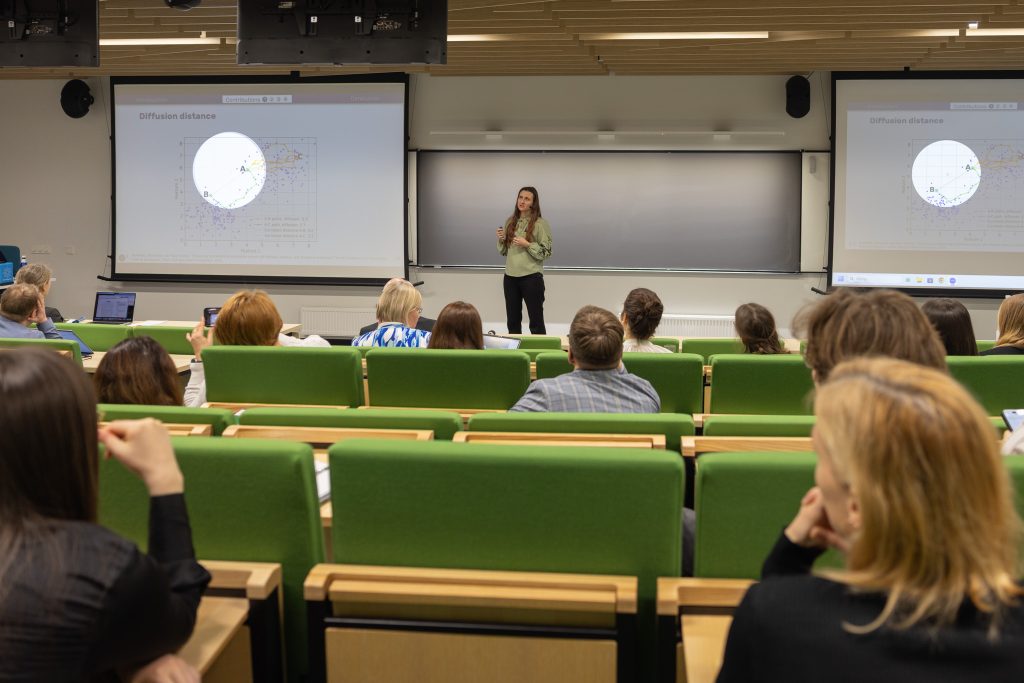
I think for every published article there were three-four abandoned beautiful ideas that didn’t work.
How is working with clinicians or domain experts different from working with computer scientists?
I had questionnaires and interviews with clinicians and domain experts and it was a learning curve for all of us to speak the same language. Especially, when I asked them to evaluate a specific or isolated part of a pipeline, they often approached the problem as a whole instead of separating it into components. At first, this felt like a mismatch, but over time I realised that this perspective was not a limitation. It reflected how real decisions are made in practice. That experience taught me that explanations which make sense in a technical pipeline do not necessarily align with how domain experts reason, and that bridging this gap is as much a design challenge as a technical one.
How did real-world data challenge your theoretical assumptions?
Explainability is something that tries to connect the trained model and the real world it is supposed to represent. When working with instance-based explanations, it becomes very clear how imperfect many model assumptions are and how underrepresented real-world data often is. What looks clean and well-defined in theory quickly breaks down once explanations have to make sense for actual cases, highlighting gaps between models, data, and reality.
Did you ever seriously consider quitting? Why?
Yes. There were several moments during my first PhD year when I was close to quitting. I mentioned earlier the COVID period and my move to Tallinn. At that time, my PhD was almost entirely remote. Most of my interactions were online meetings with consortium members, and the work within the EU project did not feel like leading to any of my publications. There were many meetings, constant coordination between partners, requests for contributions, and writing deliverables, but I did not see how this would translate into publications for my thesis. On the side, I was reading papers and trying to define my own research direction, and I found the Explainability field deeply problematic. Once I realised how difficult and, in many cases, ill-defined evaluation was, I became genuinely puzzled about how one could even publish consistently or write a coherent PhD thesis in this area.
Somewhat ironically, I did not quit during those first months partly because another PhD student who started around the same time quit very abruptly and without proper communication with her supervisors, which turned into a big scandal. I remember thinking that I should at least wait and not quit immediately after her. Shortly after that, the war started, and my life priorities shifted completely.
Looking back, I can summarise the resolution of my PhD crisis as something that came after more than a year of working mostly alone on my research ideas while contributing to the TRUST-AI project. At that point, my motivation was clearly fading. What helped was not a sudden scientific breakthrough, but conversations. A retreat in Roosta, organized by Meelis Kull for the ML, NAIL, NLP, and Biomedical Computer Vision groups, became a turning point for me. During that event, Mari-Liis Allikivi and I initiated a discussion about why PhD students rarely collaborate, what stops us from doing so, and whether collaboration could realistically lead to publications that still fit within individual theses. At the same time, everyone gave short presentations about their work, and for the first time I got a clear overview of what others were actually doing. That combination changed my approach entirely. It made me realise that isolation was not something I needed to endure silently, but something I could actively change by reaching out and building collaborations.
Is there a place or trip during your PhD that stands out in your memory?
Summer 2022 Prof. Meelis Kull organized the Roosta event with ML, NAIL, NLP and Biomedical Computer Vision groups. That event was very special, because all of us gave a short presentation about our work and I got a better overview of what everyone was working on. That event was so memorable and helped me to overcome my PhD crisis. As I was describing above at that time, I had been working alone for over a year and felt my motivation fading. During that event, together with Mari-Liis Allikivi, we initiated a discussion about collaboration among PhD students. Verbalizing those challenges and hearing other’s perspectives changed my approach entirely. Afterward, I made a list of potential projects and began sharing them with students and colleagues at PhD events, which worked really well.
How did you find collaborations during your PhD?
I realised relatively quickly that I needed to collaborate, partly because of the nature of my field. Explainability methods cannot exist in isolation: they have to be applied, tested, and verified in real contexts. Since part of my PhD was connected to the EU TRUST-AI project, I collaborated with project partners, which brought valuable experience and exposure to real applications. At the same time, those collaborations were largely driven by application needs. There was limited flexibility to explore my own ideas fully, as I often needed to provide exactly the type of output the partner expected, which sometimes felt distracting from types of publications I needed for my own PhD. Perhaps I was also still learning what my methods were truly capable of and how much freedom I could realistically claim.
A turning point came when I started writing down concrete research direction ideas and proposing them as student projects. Through this, I managed to recruit several incredibly bright and motivated students, with whom collaborations grew naturally and lasted for years. The first were Julius Välja and Rasmus Moorits Veski, who joined through the Natural and Artificial Intelligence course in October 2022. What started as a course project gradually evolved into a paper presented at AAAI 2025. Together, we spent countless hours designing the questionnaire, going through the ethics committee approval process, and conducting multiple rounds of data collection with more than 200 participants. Kadi Tulver played a crucial role in this project by bringing a cognitive science and psychology perspective and by helping us navigate both the questionnaire design and the ethical considerations. Giacomo Magnifico contributed actively to discussions around the study design and later presented our work at AAAI 2025 on short notice.
Another collaboration that brought me a lot of joy was supervising Dmytro Shvetsov. He first joined my proposed project through the Neural Networks course on generating counterfactual explanations for images, which later grew into his master’s thesis. When I saw his early results, I was reminded of Joonas Ariva’s presentation at the Roosta event (that I was talking about above) about the challenges of segmenting kidney tumors. After our first discussion, we immediately saw the potential of working together. Together with Dmytro Fishman and Joonas Ariva, we decided to join forces. The collaboration with the Biomedical Computer Vision Lab turned into a remarkably fast success story, though it required hard work and close coordination from everyone involved. In the end, we managed to put all the pieces together and complete a paper within just a few months, thanks to everyone’s tremendous effort and dedication. I also learned a great deal from Dmytro Fishman about how to approach student supervision: with structure, encouragement, and empathy, caring not only about their scientific progress but also about their mental well-being.
How do you try to maintain balance between work and life?
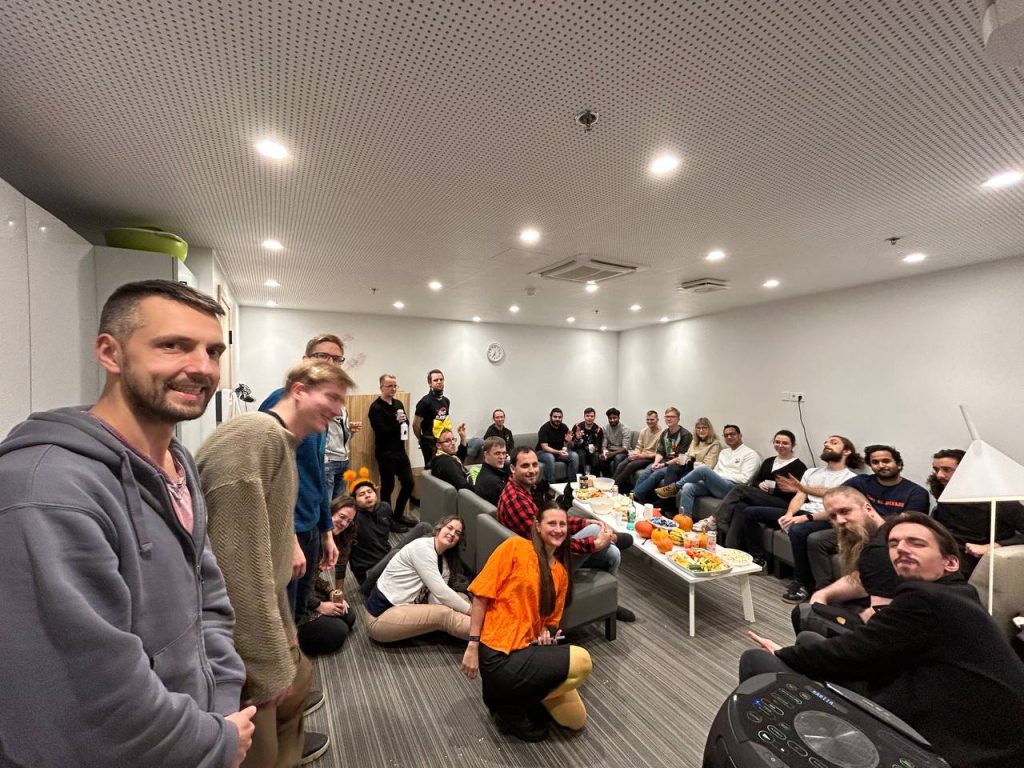
I don’t, I have periods of just work. I am very career-driven, and when I believe something is important, I tend to become fully consumed by it. I can work intensely and get a lot done in a short period of time, often at the cost of everything else. Those phases are usually followed by periods where I rest or procrastinate, sometimes for longer than I would like. This rhythm worked for me in the sense that things got done, but it came with a cost. I would not recommend this approach, and I definitely would not suggest learning from it.
On a deeper level, this work drive is not only about ambition. For many Ukrainians living abroad, there is an underlying sense of guilt. Being in Estonia while others are on the frontlines creates a constant internal pressure to justify your place. For me, that often translated into working as much as I could, trying to prove that I was useful here, that my presence made sense. Work became a way to cope with that feeling and to carry responsibility from a distance, a way of telling myself that if I was not there, I had to do everything I could here.
How much Estonian do you speak or understand now?
I can understand quite a lot, I passed the B1 Estonian state exam, I watch news and cartoons in Estonian, but speaking is more difficult because it requires regular practice and I feel that I am losing speaking skills every time the Estonian course stops.
What are you most proud of from your PhD, aside from the thesis itself?
I am proud of being involved in organizing PhD events that addressed issues many of us were experiencing but rarely named, helping build a PhD community where we felt comfortable talking openly about struggles, uncertainty, and collaboration. I am also proud of my teaching and supervision, and of the students who trusted me with their projects and stayed motivated through long, demanding collaborations.
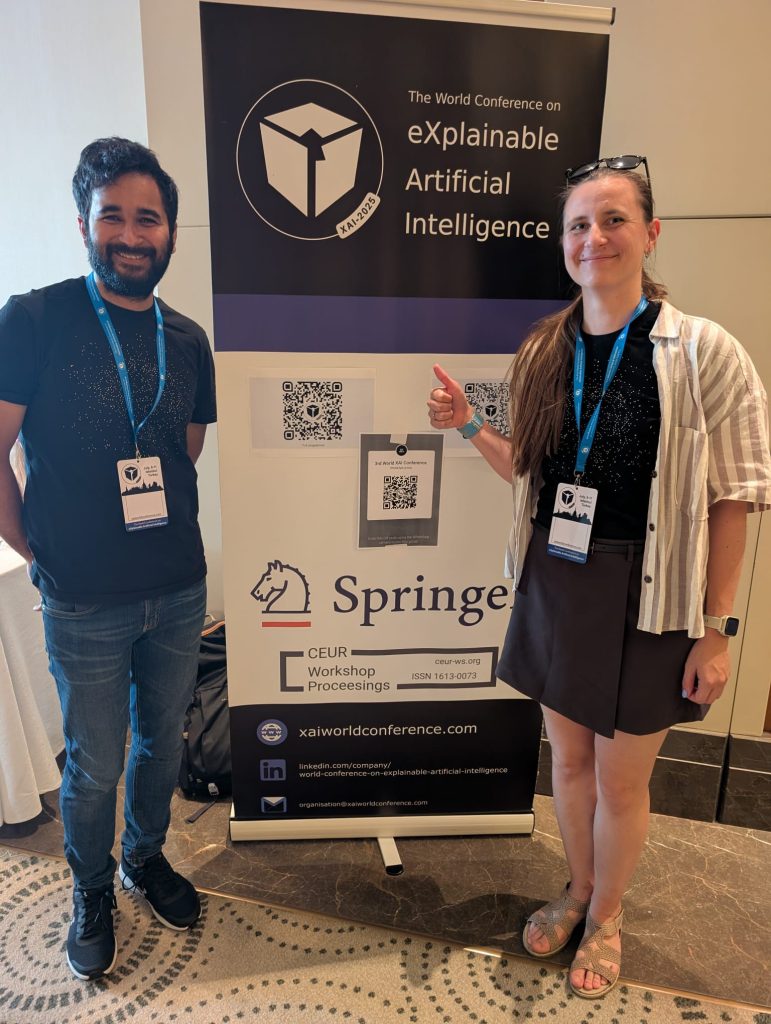
On the research side, I am especially proud of papers included in the thesis and of experience submitting and presenting at conferences, including the World Conference on Explainable Artificial Intelligence and AAAI.
If you could go back in time, would you still do a PhD? Is there any advice you would like to share with PhD students?
Yes, for sure, I would do it again. I think it is a great privilege to have so much freedom to work on the topic you care about for such a long time. I did not fully realize this at the beginning, but I now understand that this level of intellectual freedom is rare, and I may not encounter it again in the same way at any other point in my career.
Oh, I have several pieces of advice actually. From a practical perspective, try to attend smaller, your field-specific conferences whenever possible. They are important for finding your community, having real conversations, getting a reality check about research gaps, and if lucky finding collaborations.
The second piece of advice is to take ownership of your PhD as early as you can. It is amazing that we are given resources and time to pursue our own research ideas, and sometimes that means trusting yourself enough to try things even when others (your supervisor perhaps) are skeptical. If you genuinely believe in an idea, it is worth exploring it and it is ok to fail, you have time. For me, this was one of the main lessons of my journey: learning to do less of what is asked from me during the project and focus more on my own direction.
And finally, try to have fun and talk to people. Have conversations in the corridor, over coffee, or after seminars. It is very possible that someone works on something closely related to your own research, and you could spend four years working door to door without ever finding that out simply because you never asked.
How do you feel about the future right now?
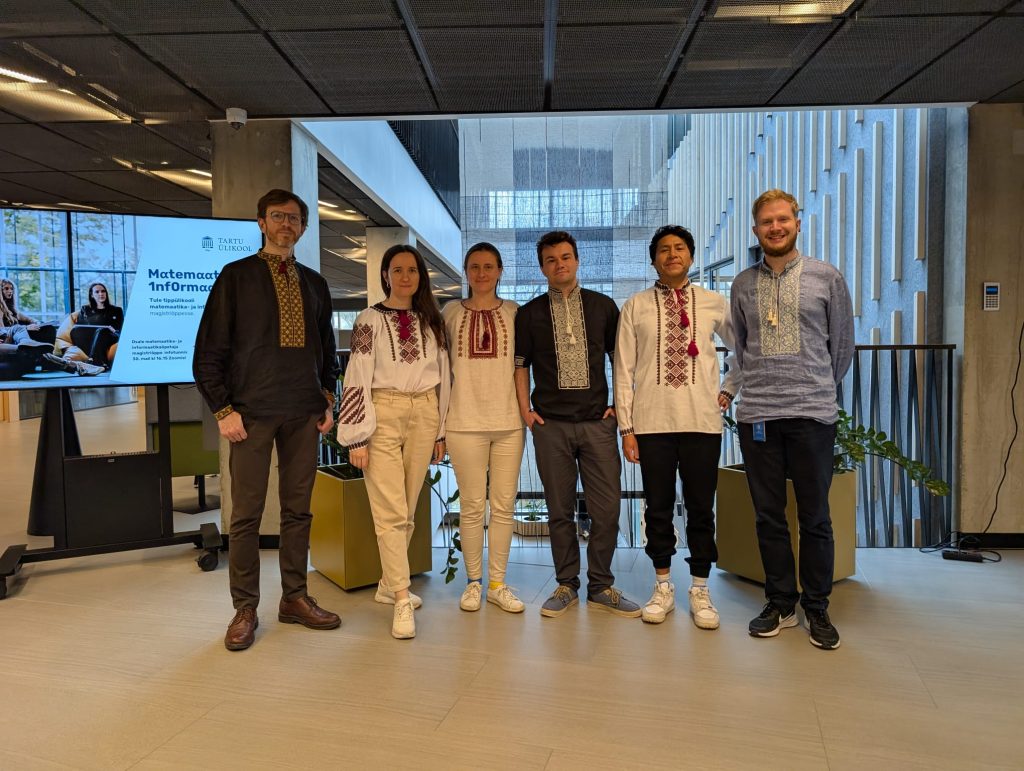
As a Ukrainian, this is a very difficult question to answer, I can’t abstract my career from reality and war. My main thoughts are to somehow stay useful for the community, for Estonia and for Ukraine and also enjoy heating, water and electricity. I will use this opportunity to express my enormous gratitude to the Armed Forces of Ukraine. I wouldn’t defend this thesis without their sacrifices and bravery keeping my family safe. I feel sorry for not doing enough. I do not know a single Ukrainian who does not share this feeling. I hope for victory, for Ukraine to remain free and independent, and I sincerely hope that Estonia and the Estonian people will never have to experience a similar struggle.
Do you see yourself in academia, industry, or somewhere in between?
Somewhere in between: I enjoy teaching and supervising, and I know that I can do research as well. But the current state of AI puts us in the position of application rather than research. I also don’t fully see this as an either-or choice. I do think it is important to help build and support startups, especially when it comes to adapting new technologies responsibly and translating research into practice.
At the same time, I strongly believe that we need to continue contributing to ethical, well-grounded, and well-represented research. If anything, the speed at which AI is being deployed makes that kind of research even more necessary. Without it, applications risk being built on weak assumptions, biased data, or poorly understood consequences. For me, the challenge is not choosing between application and research, but finding ways to keep them meaningfully connected. Which I can summarize that I don’t really know and I’m open to conversations about how to do that well 🙂