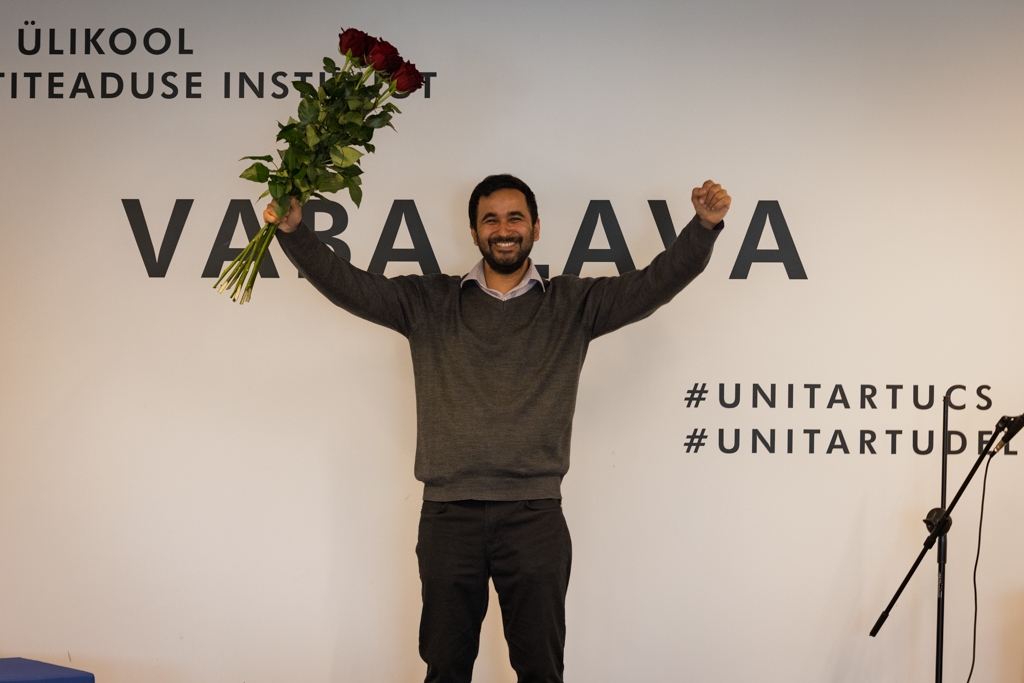
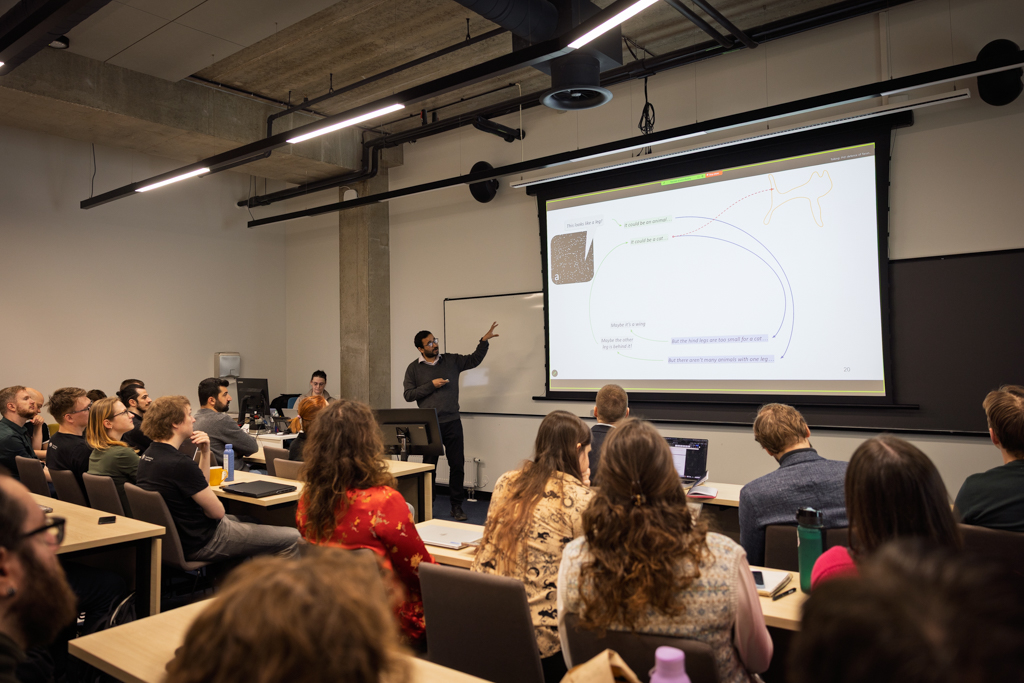
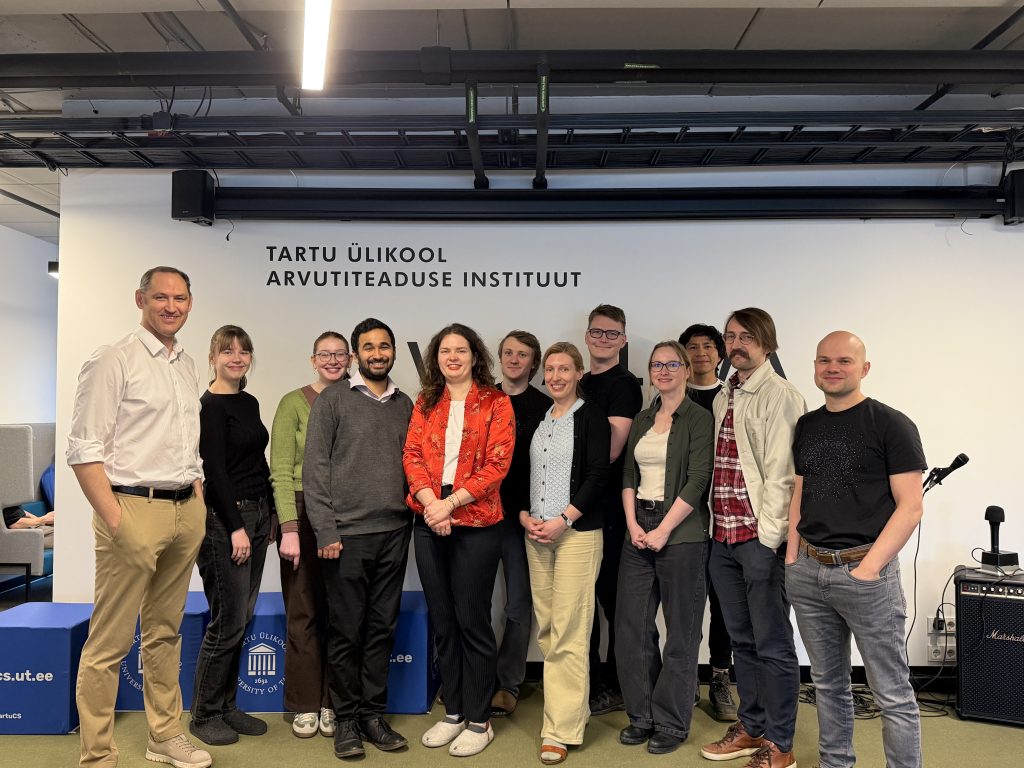
On 28 April 2026, Tarun Khajuria defended his doctoral dissertation titled “Scene understanding in human and computer vision” (supervised by Jaan Aru). On this occasion Laura Altin, communication manager at the Estonian Centre of Excellence in AI (EXAI), spoke with Tarun about his journey into research and the possible next steps in his professional path.
If you had to describe your PhD in one sentence today, what would it be?
Comparing humans and AI on how we see things.
Let’s get back to the beginning of your PhD. When you started your PhD studies, what were your feelings and expectations?
I had already worked with the same people, like Raul Vicente Zafra and Jaan Aru, during my master’s. Raul was my main supervisor in my master’s, so the topics were somewhat similar. But starting a PhD was still different from what I had done before.
I started in 2020, during the COVID year, and as soon as I began, the centre closed, so we had to work from home for almost a year. I remember that after the first year, my main feeling was that I had done many explorative things, but nothing felt concrete yet. I felt a bit lost.
I even remember telling my supervisor that I did not think we were doing very well, but he told me that I was actually doing quite well. I think the difficulty was that I did not know how to measure progress. In the first year, I read a lot, wrote some things that I never published, and did a lot of work, but it was very hard to see clear progress.
Did you stay in Estonia at that time?
Yes.
What is the biggest misconception people have about doing a PhD?
I do not know if I had a big misconception myself, but the biggest thing I learned was how important it is to understand the setting in which you are doing your PhD.
Even though I was working in the same lab, the lab changed during my studies. The focus shifted more from computational work to human-centred work, and the people in the lab also changed. I did not realize at first how much the surrounding environment would affect my PhD experience.
At some point, it became important to figure out: this is the environment I am in; this is what I can do in this environment, this is my strength, this is the lab’s strength, this is what my supervisor can give me, and this is what I need to ask for. Once you understand those things, it becomes much easier to work clearly. But it takes time, and nobody really tells you that explicitly.
Was your topic offered by your supervisor, or did it come out in collaboration?
The project idea was offered by my supervisor, but the implementation had to be done from scratch.
There was a rough idea that we would create some kind of dataset that could be tested on humans and AI and reveal differences between them, something resembling constellations. That was the brief. Everything else had to be figured out: what kind of dataset it would be, what kind of images we would use, and so on.
That was also a bit tricky, because when the idea comes from the supervisor, it takes time to understand how much they have already thought about it and how it relates to current knowledge. He had a very general idea, which he tried to convey to me, and I had to build something substantial from it.
Did you consider any alternatives to a PhD, like industry?
Yes. When I started, I had basically been offered the PhD through the people I was already working with during my master’s. At the same time, I had already started interviewing for industry positions near the end of my master’s.
Raul told me that Jan was coming back and might want PhD students, and that if I wanted to join the lab more formally, this could be an option. So, I wrote a proposal for Jan’s project, and that is how I got in.
But I was already halfway through interviews for industry positions. If I had not gotten the PhD here, I would most likely have gone directly into industry.
Would that have been in Estonia?
Yes, in Estonia.
How long have you stayed in Estonia, and how did you find Estonia?
I have been here since 2018, so almost eight years now.
The main reason I came was that Estonia offered free education for my master’s. But it was not only that. I had applied to a lot of neuroscience programmes before, and not many computer science programmes. I did not have a neuroscience background, so I did not get into most of those neuroscience programmes, or I did not get full funding.
What attracted me to Estonia was that there was a computational neuroscience lab, and I could work with people in that field during my master’s. Even my statement of purpose for the master’s already matched quite well with what I eventually wanted to do in my PhD.
So, it was a combination of things: it was a computer science programme that accepted me, there was a neuroscience lab, the position was funded, and when I first came, I also received a scholarship, so practically everything was covered.
What was your first impression? Had you been in Estonia before?
No, I had not been to Estonia before, and I did not know much about it. I had only heard of Estonia about a year earlier, because an Estonian minister had visited the institute where I was working at the time.
I was working at IIIT Delhi, the Indraprastha Institute of Information Technology. I was doing research-associate-type work for their incubation centre, mostly administrative and research-related work.
What was your first impression when you came to Estonia, as a country?
Estonia felt like the complete opposite of what I had experienced in my life before, because I had lived in Delhi, which is a very densely populated area.
I always tell people that India and Estonia differ by a factor of a thousand. India has about a thousand times more people, and the population density is also dramatically different. So many things are on completely different scales, including how people behave in those environments.
That said, I did not find it difficult in a negative way. I was pleasantly surprised. At the institute, I met a lot of people I could relate to, so I did not feel the cultural difference for very long. During my first year, I was mostly amazed by all the new things happening around me, Christmas traditions and other things I had never experienced before.
Can you name some surprises?
I think I was just super happy with the snow. I come from the foothills of the Himalayas, so I always saw snow in the distance, but I did not really experience it much while growing up. I visited the Himalayas later in life, but snow always felt like something connected with travel and holidays.
So, when I came here, it felt amazing that snow was just part of everyday life. I thought, “You get this for free here; you do not need to go on holiday for it.” I was very happy about that, and honestly, I still like the weather in general.
Have you had any interesting misunderstandings or experiences in Estonia that made you think, “What are they doing?”
Mostly social experiences. Sometimes I had evenings where I talked for a while with someone at a party, and then the next day they would not really acknowledge me if we passed each other. That felt socially awkward to me.
But I do not think that is something very general. I think people here often have a more private personal life, and it took me some time to realize that. Some things are just kept more separate. Still, I think it is more person-to-person and not a universal Estonian thing. When I asked my Estonian friends about it, they also said it is not so general.
Nothing was spectacularly shocking. Maybe I also expected things to be different, so I was not too surprised by differences.
You mentioned stereotypes. Can you mention some stereotypes you were expecting?
One stereotype I heard was that people here are unfriendly, or that Estonians are very private.
But before coming, I knew so little about Estonia that I did not even really know the stereotypes. It was only later, in my first years here, that I started hearing things like “Estonians are private,” “it is difficult to make Estonian friends,” and so on.
At least in my PhD experience, that did not really turn out to be true. In my master’s, foreign students often stayed mostly with other foreign students, and that was true for me too. But I still made at least one Estonian friend in the first year of my master’s, and that friendship has lasted throughout my whole time in Estonia. He is even coming to my defence.
So, I do not think the stereotype is true, at least not in a simple way.
14. Do Estonians do something funny or strange every day that still feels unusual to you?
Now I have lived here so long that I do not know anymore. Maybe I do the same things now.
But sauna culture, and especially changing rooms, was something I had to get used to. In my culture, we usually still wear something in front of people we do not know, so being naked in changing rooms felt unusual at first. It was not a huge shock, because I already knew that in some places this is normal, but it still took some getting used to.
There was also a funny incident when I lived in the dorm during COVID. On New Year’s morning, I woke up, opened the curtain, and saw people outside rolling naked in the snow. I was completely confused and thought, “What is happening?” I wrote to my friends, and they told me that they were probably doing sauna and then going out into the snow. Then it made more sense.
What has been the most difficult moment during your PhD so far, and have you ever considered quitting?
For me, the most difficult period came when I was already quite sure that I could defend, but I was still stuck with some papers.
I had my first paper, and the second paper was submitted, but it got rejected twice. I had a lot of faith in that paper because I had done the work myself, and the reviews were positive enough that I could see people understood its value. But every time the reviews came back, there was more work to do, and each time the reasons were a bit different. It became difficult because you start wondering how long the cycle will continue. That paper was finally accepted on the fourth try.
The other difficulty was with the last paper, which was a major part of my thesis. It took time to complete the experiments and fully materialize the work. By the later stages of a PhD, you are often simply tired. You have worked on the topic for so long, and there is always still something left to do. You feel that you are almost there, but there is still a lot that must fall into place before the PhD is done.
I would say that later stage was especially difficult. The very first years were also difficult, but in a different way, because then you are still trying to understand what doing a PhD even means.
How did you overcome this obstacle?
Mostly, it worked out because I had very good colleagues. I had a postdoc colleague who was really encouraging and helped me a lot.
When your supervisor says, “It will work out,” after a while you may stop fully trusting that because they are always encouraging you. But when another experienced person, like a postdoc, says the same thing and explains that this is just how papers go, it gives you more confidence.
During the later years of my PhD, I also started asking more people for help. That was very important. Whenever I presented my work, I would invite Raul, Meelis Kull, and others, so that several senior people would see my work. Their comments and questions helped me understand that the work still had value.
Talking to more people gave me more confidence. I realized I did not have to rely only on my supervisor; I could ask colleagues, even from other labs, for help and discussion. That made a big difference.
I also started taking reviews more positively. Even when a paper was rejected, if some parts of the review were positive, that helped me see that the work had value. At some point, confidence cannot come only from you and your supervisor. Sending work out, getting reviews, and getting input from more people helped me continue.
What do you do in your free time when you are not doing research?
That is something that helps a lot during a PhD, because the wins come very slowly.
At one point, I did Indian folk dancing, specifically bhangra, which is the folk dance of my region. I had never really learned it properly in India, but in Estonia I joined a group because one of my friends knew it very well and was teaching it. It was a lot of fun, and I basically learned my own folk dance here.
Later, that person graduated and we no longer had a trainer, so then I got into running and badminton. Right now, I do a lot of running and badminton.
How do you keep a balance between work and personal life?
Most of the balance comes from the fact that I work at the institute. I usually come in the morning and leave in the evening, and that is when I mostly work.
Of course, depending on deadlines, sometimes you need to do more, and then you might also work on weekends. But I think I have a very fixed schedule for personal things, and I usually do not change those. Instead, the work schedule changes around my personal life.
This is something I learned in Estonia. In India, I think we often have a poor work-life balance. Here, I learned that I could schedule meetings with friends, trainings, and other personal goals, and keep those in my life in a more structured way.
So personal life was never too much, but it was fixed and protected. Then the rest of the time I went to work. Occasionally I had to cancel personal plans, of course, but most of the time things were scheduled well enough that I could enjoy both work and personal life.
Have you tried to learn any Estonian?
Yes, I did. During COVID, I took the first levels, around A1, maybe part of A2. The classes were split into two parts here. I did two classes, but at some point, I gave up, partly because of COVID and other disruptions. I basically derailed from it completely.
Can you say something in Estonian?
“Aitäh.” That is probably the one I use the most.
I also joke that I may have some badminton vocabulary in Estonian, because most of the people I play badminton with are Estonians. Training is in Estonian, and over time I pick things up. Sometimes I still need extra clarification, but that is how I manage.
How has the PhD changed the way you think?
It has, although it is hard to pinpoint exactly how.
I was already doing research-related things during my master’s, but the PhD taught me a lot more about the process of research. I would say that one of the biggest changes is understanding how to manage work and research, especially in relation to other people.
In a master’s, you are not usually owning a whole line of work yourself. In a PhD, you do. Your supervisor is working on many things, but this particular line of work becomes yours, and you have to figure out where it gets stuck and how to move it forward.
So, I think the biggest change has been in management: managing work, expectations, and communication. Scientifically, you also learn to think very deeply, especially because you stay in one topic for such a long time. I have had almost six years to follow the progress of the field and my own progress at the same time.
Now, later in my PhD, I also review many papers, and critically evaluating other people’s work teaches me a lot about how I should write my own work. So overall, I would say the PhD changed how I think especially in terms of managing research, communicating it, structuring papers, and understanding the human side of science.
What are your next plans or dreams after getting a PhD?
I would love to stay in academia as long as I can. That is my goal.
I am already looking into postdoc positions, although nothing is confirmed yet. Long term, I would really like to continue in academia. I enjoy research, I like the pace of it, and I also enjoy supervising students. I have had some experience supervising master’s and bachelor’s students, and I liked working both with people who are more senior than me and with people who are still learning.
So, I would like to continue in that direction, although I also understand that it is not always easy.
Can you describe in a simple and general way what your thesis is about, what the core results are, and how it might change the world?
I would not say that we are changing the world directly, but we do analyze how humans and AI see things differently.
There is a lot of work in computer vision now where AI models can classify images and describe what is in them. They can tell you if there is a cat or a dog in an image or describe a relationship such as a cat sitting on a sofa.
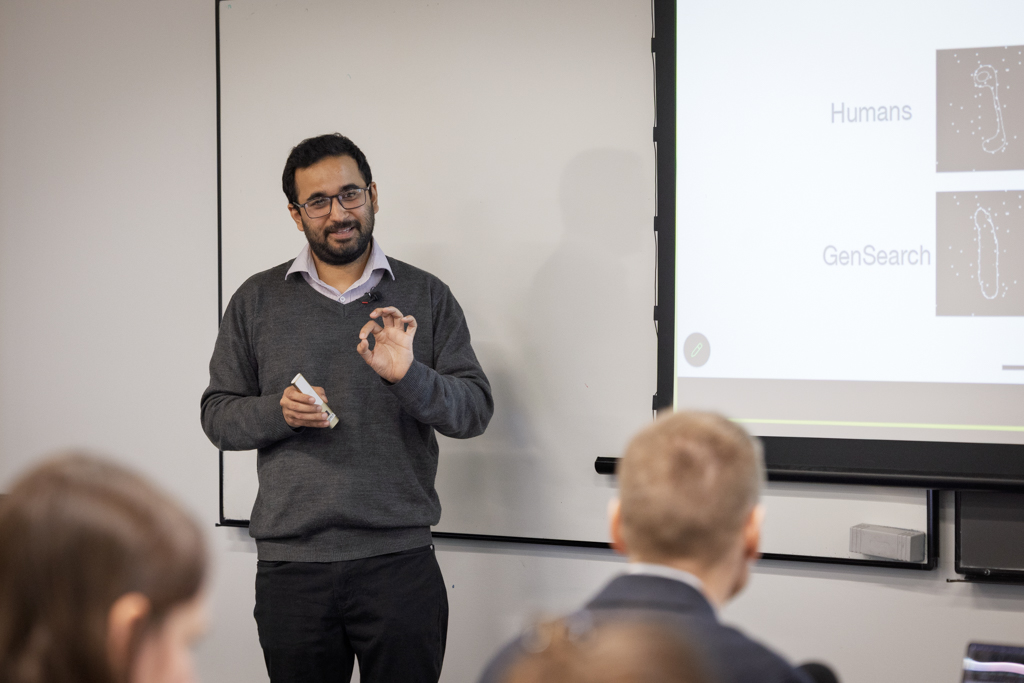
My work gives these systems images that are very easy for humans to solve but still difficult for AI. These images are similar to constellations, where humans can see meaningful shapes in stars. We try to create these kinds of shapes and hide them in patterns.
Then we study how humans find these shapes and how AI models try to find them. This reveals differences between the two. It shows that even though AI is often claimed to perform better than humans, that is not true in every case. Human vision is still more robust in some situations. Humans can still perceive the same thing even when a lot changes, while AI may fail or behave differently once you move beyond what it was trained for.
So the thesis helps point out where human vision and AI differ, and why it matters. If AI is supposed to work for humans and do things humans do, then it should in some ways perceive the world more like humans do. My work helps identify where that is not yet the case.
What are three things you will do after your defence?
Maybe swim a bit, since summer is coming. A nice barbecue would be good. And maybe travel a bit. I have not travelled much this year because of thesis work, so I would like to go out of Estonia for a while and maybe visit some people.
What would you recommend to prospective doctoral students?
The main message for someone considering starting a PhD would be this: you need to get a clear picture of your own situation. Everyone is in a different position, and the first step is to understand where you are right now.
You shouldn’t assume that someone else’s schedule or the order in which they do things should match yours. Their circumstances may be different, and therefore their PhD experience will be different too. This has been the most important lesson for me personally.
So, my recommendation is: first, think through your own situation. Clarify what your environment is like, your supervisor, your lab, what your strengths are, and what kind of support you can expect to receive. Don’t compare your progress too directly with someone else’s, because your situations are not the same.